Standardising & Automating Property Transformation Processes
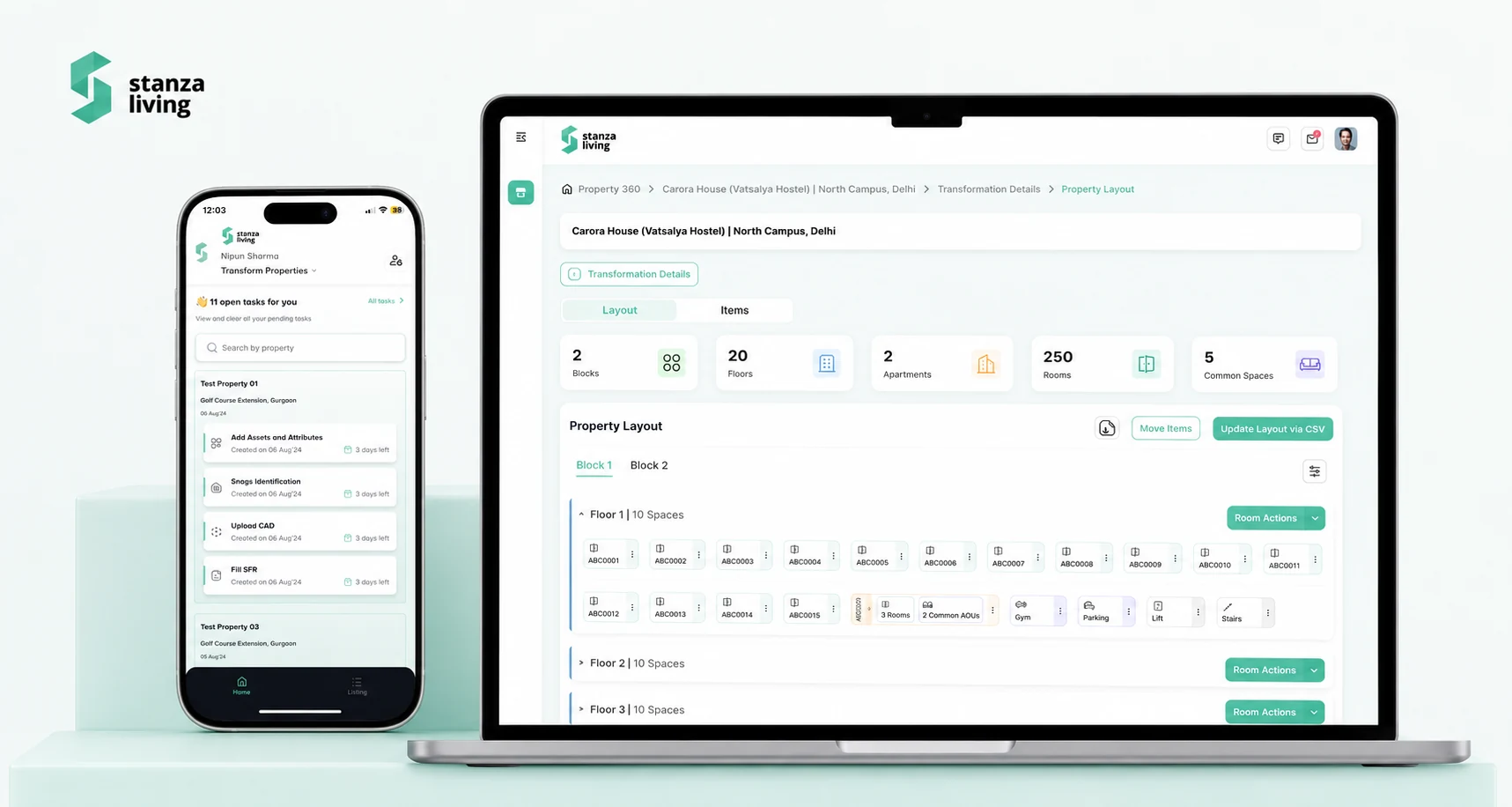
A task-based SOP and a unified system across mobile and web, replacing scattered spreadsheets and manual handoffs with a standard workflow that gets every property investor-ready.
About Stanza Living
Stanza Living is India's largest managed-accommodation brand, co-living for students and young professionals moving to a new city for college or a first job. Instead of the usual broker, bare flat, and no support, Stanza leases entire buildings, furnishes and staffs them, and hands residents a fully-serviced, move-in-ready home. That promise only works at the front end if the back end can turn a leased, empty building into a standardised, investor-ready property, fast and predictably. This is the system that made that possible, at the scale below.
The numbers
The scale this system runs at today.
Stanza Living revenue, FY 2023
Residents housed on the platform
Properties Stanza manages
Cities & towns across India
The problem
Every empty building Stanza leased had to become a finished, move-in-ready home, but there was no real process behind that. Data lived in scattered Excel sheets, three teams worked off disconnected tools, and nobody could say with any confidence when a property would actually be ready. Every extra day a building sat unfinished was a day of rent it wasn't earning. The mandate: one SOP for the entire property lifecycle, then a system to enforce it.
The property lifecycle
Before getting into what was broken, it helps to see the journey itself: what a property goes through between the day Stanza signs the lease and the day residents move in. This is that path, stage by stage.
Property onboarding
PnL gives the go-ahead; naming is set.
Data collection
Structural and asset data captured on-site.
Modification
Architects propose changes via CAD drawings.
Bed count finalisation
Bed count and SKU mix locked in.
Procurement
BOQs and POs raised for materials.
Transformation
Ground team executes the physical rebuild.
LLHO
Landlord hands the property to Stanza.
HOTO
Operations go live at the property.
Property onboarding
PnL gives the go-ahead; naming is set.
Data collection
Structural and asset data captured on-site.
Modification
Architects propose changes via CAD drawings.
Bed count finalisation
Bed count and SKU mix locked in.
Procurement
BOQs and POs raised for materials.
Transformation
Ground team executes the physical rebuild.
LLHO
Landlord hands the property to Stanza.
HOTO
Operations go live at the property.
What was broken
With that path in mind, here's what was actually going wrong at each turn, in plain terms.
A lack of SOP
A scattered process, with no defined timeline.
Tedious manual processes
Manual capture in Excel, manual analysis.
No unified system
Data split across disconnected point solutions.
Junk data
Unapproved entries let errors into the system.
Long turnaround time
Manual analysis and procurement slowed everything down.
Opportunity cost
Every idle day cost real revenue.
The approach
Rather than patch each symptom, I wanted one process the whole team could trust, and a system that made following it the easy option.
Understand the workflow
Mapped how a property really moved, team by team.
Standardise with a task-based SOP
Sequenced tasks per team, each with a checkpoint.
Automate the redundant steps
Pushed default data automatically, no manual entry needed.
Design one unified system
One system across Sigma and NucleusX, per persona.
Who this was for
Every property passed through three different teams, each with their own job, their own tools, and their own frustration with how disconnected everything was.
Transformation Manager
The person on the ground at every new property, walking each floor to capture structural and asset data room by room and handing it to the Design team to work from.
Goal
Capture each property's data once, accurately, without repeat visits or rework.
Major pain point
Constant back-and-forth re-confirming and re-sending data that was already submitted.
Design Team
Turns that raw site data into a modification plan, proposes changes through CAD drawings, and raises the BOQ that procurement then acts on.
Goal
Analyse a property fast and raise an accurate BOQ without manual, repetitive work.
Major pain point
Slow, manual analysis and BOQs assembled by hand in disconnected spreadsheets.
PnL Team
Owns the commercials, setting the bed count and approving the BOQ to keep CapEx and OpEx in check for every property that goes live.
Goal
See cost, bed count and returns in one place to price each property with confidence.
Major pain point
No single system tying property data, cost and approvals together in one view.
How the SOP was built
Once the workflow was mapped, the next step was writing it down as a real standard operating procedure, sequenced task by task, and building software that made following it the default, not the exception.
The task flow
Transformation Manager
Design Team
PnL Team
Principles behind it
Identify key tasks
Map the full workflow.
Assign responsibilities
One clear owner per task.
Sequence execution
Each step builds on the last.
Checkpoints & approvals
Catch errors early.
Feedback & adjustments
Keep the SOP dynamic.
What it protects
Reducing human intervention
A lot of the old process was people re-typing data that already existed elsewhere. Here's what changed once the system started filling that in for them.
Previous workflow
New workflow
Tools & stack
The solution
A written SOP only holds if the software makes following it the easiest thing to do. That meant two surfaces rather than one: a mobile app the Transformation Manager carries around a half-built property, and a web console where the Design and PnL teams pick up everything it sends back.
One property, two surfaces
Phone and web run off one task list, against the same property and the same data.
Sigma — the field app
Task-based capture on site: SFR and meter details, attributes, assets and snags, CAD floor by floor.
NucleusX — the web console
Layout, room-level detail, and the Master BoQ with strategy deviations flagged before approval.
Impact
The numbers below are what actually moved after this went live across the portfolio.
reduction in property transformation turnaround time (TAT)
reduction in manual human intervention across the workflow
properties running on the new system, across 20+ Indian cities
platforms shipped: Sigma for the ground team, NucleusX for Design & PnL